
Author: Nalene de Klerk (The Corporate Reporters)
April 2024
With an ever-sharpening public focus on corporate transparency and accountability, the past three years have seen a significant shift in the integrated, sustainability and ESG reporting landscape in terms of frameworks and standards.
The IFRS Sustainability Disclosure Standards (S1 and S2), issued in June 2023 by the International Sustainability Standards Board (ISSB), “ushered in a new era of sustainability-related financial disclosures in capital markets worldwide,” according to the IFRS Foundation.

But what exactly are these disclosure standards, how do they differ from existing frameworks, and what implications do they have for your organisation? These are some of the topics we cover in this article.
What is the purpose of these disclosure standards?
The primary focus of the S1 and S2 disclosures is to shed light on sustainability-related risks and opportunities that significantly influence an organisation’s financial health. They are specifically geared towards meeting investor information needs, accompanying the financial statements in the annual report. In the words of the ISSB, such reporting should contain:
The disclosures are based on the work of the Task Force on Climate-Related Financial Disclosures (TCFD). In fact, the TCFD sees the publication of the standards as the culmination of its work and transferred its responsibilities to the ISSB from 2024.
At this point, it is also important to understand that the purpose of the IFRS Sustainability Disclosure Standards is not to showcase a company’s impacts on its environment and society – there are other reporting frameworks for that.
Where do the S1 and S2 disclosures fit?
To understand how the ISSB sustainability disclosure standards fit into the alphabet soup of a sustainability reporting guidance universe, it is critical to understand what “materiality” means.
For those who are not well-versed in accounting concepts: material issues, according to the IFRS Foundation, include anything that “could reasonably be expected to affect investor decisions.” Simply put, the matters that impact the organisation’s financial performance – now and in the future.
On the other hand, the Global Reporting Initiative (GRI) – one of the most commonly-used sustainability standards in the world – defines material topics differently. These are the topics that “represent an organization’s most significant impacts on the economy, environment and people, including impacts on human rights.”
This brings us to the concept of “double materiality,” where organisations are expected to report not only on how external factors impact them but also on their own impact on the wider world.
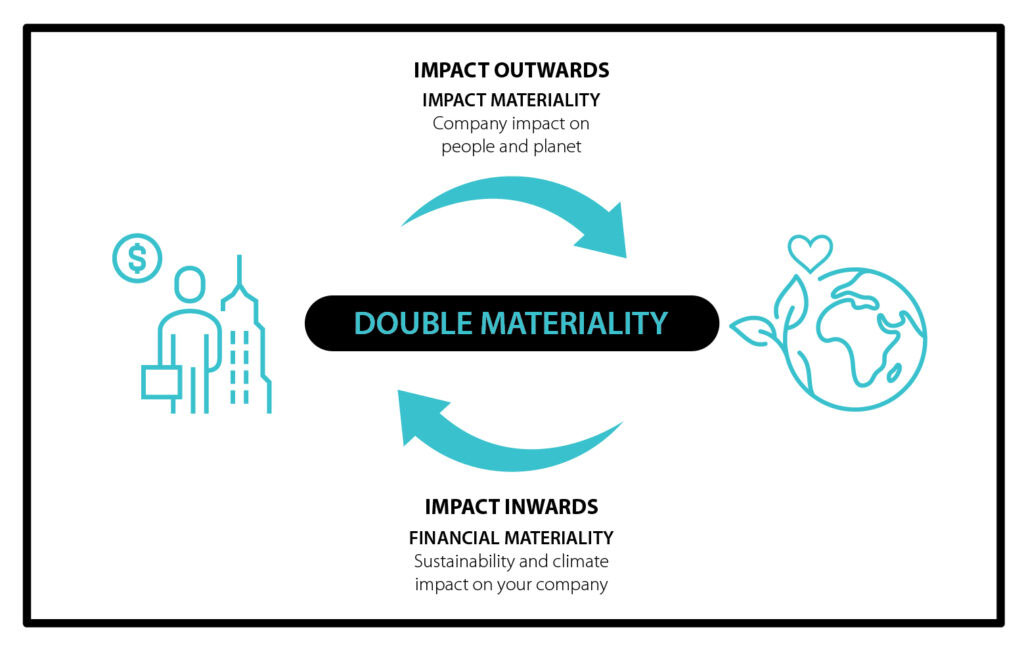
For the purpose of the ISSB’s Sustainability Financial Disclosures, your organisation needs to report on material external factors that impact your organisation’s financial performance.
What does this mean if your organisation has used other frameworks and standards until now? Well, the IFRS Sustainability Disclosure Standards are not meant to replace or compete with existing sustainability reporting frameworks and standards. Rather, it aims to complement and build on these frameworks and standards by providing a common and consistent foundation for sustainability-related financial disclosures. We cover some of the other frameworks and standards in play currently.
GRI
The GRI standards complement the ISSB standards by providing the other leg of “double materiality.” GRI and the IFRS Foundation have signed a memorandum of understanding (MoU), committing to work together to ensure that their standards complement each other.
Disclosures against the GRI standards are often published in a sustainability or ESG report, separately from the financial report. This report is intended for a broader group of stakeholders than just investors and explains how the organisation impacts on the world around it. Other companies combine the annual report and sustainability disclosures in an integrated reporting suite. Your company’s approach depends on its unique reporting history, available data, and audience.
The International <IR> Framework
The International <IR> Framework is the framework that guides integrated reporting globally. It promotes the publication of an integrated report that provides a concise communication of how an organisation creates value over time by integrating financial and non-financial information. The Framework was initially developed by the International Integrated Reporting Council (IIRC), which has since been absorbed into the IFRS Foundation as part of the ISSB. The ISSB is now custodian of this Framework, as it is of the S1 and S2 standards.
The <IR> Framework is compatible and complementary with the IFRS Sustainability Disclosure Standards, as they share the same objective of providing relevant and reliable information to investors and other capital market participants. The Framework can be used to provide a broader context and connectivity for the sustainability-related financial disclosures required by the IFRS Sustainability Disclosure Standards.
Therefore, if your organisation has been using the International <IR> Framework to compile its reports, it can continue to do so, as long as it also complies with the IFRS Sustainability Disclosure Standards.
The Sustainability Accounting Standards Board (SASB) standards
SASB was incorporated into the IFRS Foundation alongside the IIRC. However, while the <IR> Framework is industry-agnostic, the SASB standards are industry-specific, covering 77 different industries as at November 2023.
The IFRS Sustainability Disclosure Guidance specifically states that an organisation wishing to comply with S1 and S2 must find and report against its industry’s specific SASB standard(s). Although these standards were initially geared for report preparers in mainly the United States – including some region-specific disclosures that were not necessarily relevant to those outside North America – reporting against the SASB standards recently became much easier. Amendments published in December 2023 revised the SASB standards to make them more jurisdictionally-agnostic.
In summary…
The standards above are not exhaustive. You might refer to the European Sustainability Reporting Standards (ESRS) – or, indeed, other regional frameworks such as the JSE Sustainability Disclosure Guidance in South Africa – as well as the United Nations Sustainable Development Goals (UNSDGs) and the information requirements of the CDP, MSCI, and other ratings agencies.
The IFRS Sustainability Disclosure Standards promote a “building blocks” approach through a core set of disclosures that are relevant for investors and capital markets. Reporters build on these by accessing other frameworks and standards for
additional disclosures that are relevant to their specific stakeholders, or to report on specific sectors or regions. The important thing is that the information your company reports fits the needs of your particular stakeholders, while adhering to principles of transparency.
Are the standards compulsory?
The ISSB is not a regulatory body and cannot prescribe that companies adopt its standards. The IFRS Sustainability Disclosure Standards are therefore not mandatory, though they could become so in forthcoming years.
However, they are designed to be widely adopted by jurisdictions that want to improve the quality and consistency of sustainability-related financial disclosures.
In July 2023, these standards were endorsed by the International Organization of Securities Commissions (IOSCO), which represents the world’s securities regulators and sets global standards for capital markets. IOSCO has also encouraged its members to consider the use of these standards for issuers under their jurisdictions. Why is this noteworthy? Because IOSCO’s 130 member jurisdictions regulate over 95% of the world’s financial markets.
Therefore, depending on where your company operates and what regulations apply to you, you may be required or encouraged to adopt the IFRS Sustainability Disclosure Standards soon.
When do they come into effect?
IFRS S1 and IFRS S2 are effective for annual reporting periods beginning on or after 1 January 2024.
While most jurisdictions and regulators may not have mandated reporting against these standards by this date, companies are advised to make an early start. Let’s have a brief look at the topics covered in the S1 and S2 standards.
Next steps:
In summary, the IFRS Sustainability Disclosure Standards guide how organisations report on sustainability risks and opportunities to their investors. While these are not yet compulsory in most markets, it is likely that regulators in many of the world’s top capital markets will require organisations to report against S1 and S2 soon. It is therefore best to start working on collecting and reporting the necessary data as soon as possible – especially given the complexity of the reporting landscape. Ultimately, how and when your organisation reports against S1 and S2 depends on your unique audience and your reporting history.
We are happy to support: www.futurefocus.africa
Republished with the permission of The Corporate Reporters, an FFL partner company.